If you’re buying a new TV this side of Christmas, you’ll see three names on the box or in the menus: Freeview, Freesat and Freely. All three give you the main channels with no subscription. The difference is how the pictures get to your house, and that’s where your address matters more than the brand.
Three ways to get the same free channels
All three are run by the same company, Everyone TV. Here’s how they compare in practice.
| Service | What you need | Without broadband? |
|---|---|---|
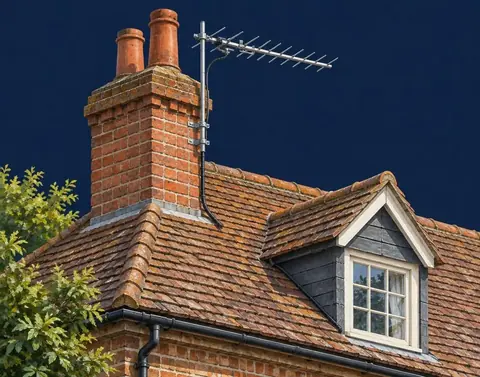
| Freeview | A roof or loft aerial and a Freeview TV or box | Works |
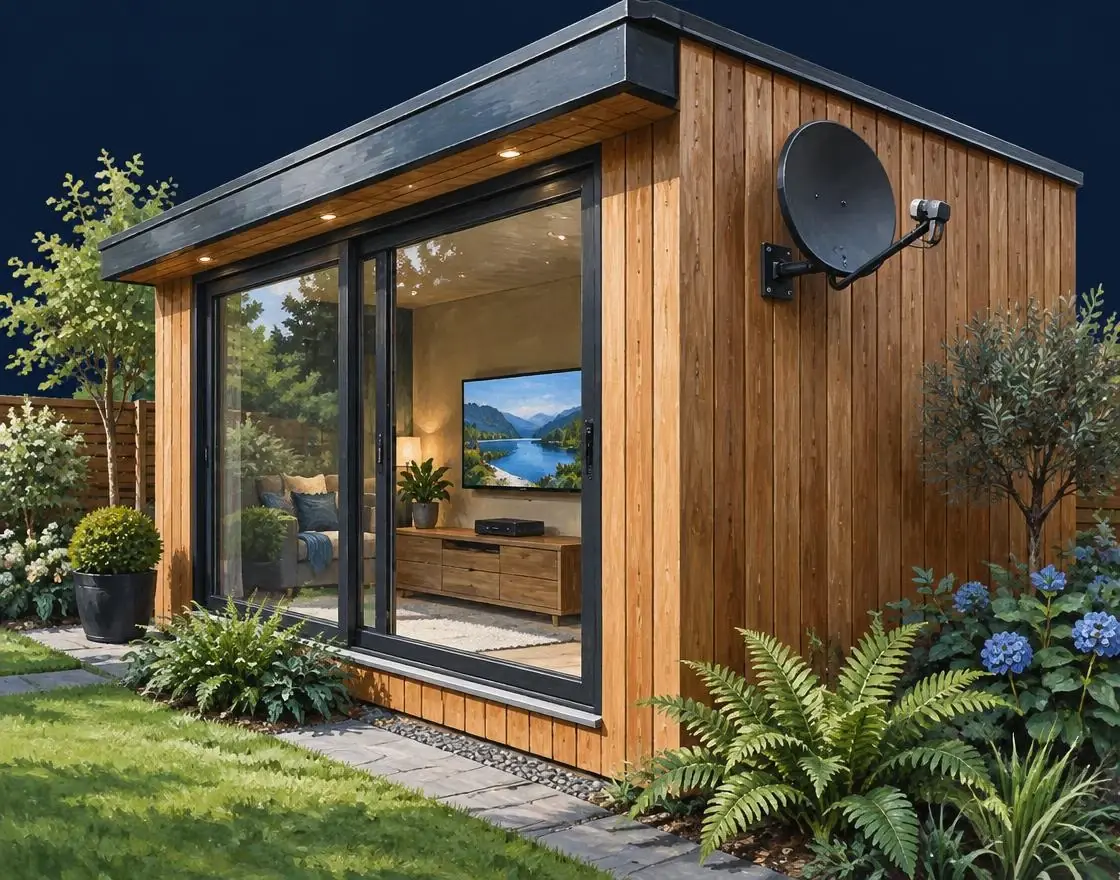
| Freesat | A satellite dish with a clear view of the satellite, and a Freesat TV or box | Works |
| Freely | A Freely TV or streaming box, and broadband of at least 10Mbps | Only channels from an aerial |
According to Which?, Freeview has more than 70 TV channels and Freesat has more, including more in HD. Freely streams live channels from the main broadcasters and others, and a Freely TV still has an aerial socket. Plug an aerial in and you get extra channels that aren’t available over the internet, and live TV that keeps going when your broadband doesn’t.
When Freeview is still the right answer
For most homes in Surrey and Berkshire, a good aerial pointed at a main transmitter such as Crystal Palace, Hannington or Midhurst gives you the full Freeview line-up. If your picture is steady and you get every channel you want, you don’t need to change anything, and you don’t need us.
Freeview is also guaranteed until at least the end of 2034. The government still hasn’t decided whether to move TV online after that or keep a smaller Freeview going to 2044. A poll published on 12 November found strong public support for keeping it on air to 2044, and the government is due to set out its plans for the next BBC Charter by the end of this year. Campaigners want Freeview’s future settled at the same time. We cover the detail in our article on the Freeview switch-off. The short version: an aerial fitted today still has years of use in it.
When Freesat makes more sense
Freesat comes from a satellite, so it doesn’t depend on which transmitter you can see or how many channels it carries. That matters in three common situations.
You’re stuck on a small relay
Where hills block a main transmitter, homes are served by smaller relays, and relays carry fewer channels. Alton is a good example. Its relay serves around 5,300 homes and is a “Freeview Light” site, with only the three public service multiplexes. That means BBC, ITV, Channel 4 and Channel 5, but not the full line-up. Many homes can point an aerial at Hannington instead, as we explain on our Alton aerial page. Where that isn’t possible, Freesat gets you everything without relying on the relay.
Hills and trees get in the way
Around Cranleigh, Ewhurst and Alfold, homes sit low in the Weald with Pitch Hill and the Surrey Hills to the north. Depending on the street, the aerial signal can be weak, and tall trees can make it worse in summer. A dish doesn’t care about the hills in the same way. It does care about trees, though. It needs a clear line to the satellite in the south-eastern sky, and a big oak in leaf can block a dish just as well as it blocks an aerial. We check both before recommending either.
You’re on the edge of two TV regions
Some towns sit on the boundary between the London and South regions. In Godalming, homes a few streets apart can point at Midhurst, Crystal Palace or the Guildford relay, and get different regional news depending on which one works. With Freesat, your box sets the regional channels from your postcode, and on many boxes you can change them in the settings. You get the full channel list wherever you are in the Wey valley.
Godalming’s old town is also a conservation area, which brings us to the catch.
Before you fit a dish
Most houses can have a dish without planning permission, within size and position limits. The rules are stricter in conservation areas and Areas of Outstanding Natural Beauty, such as the Surrey Hills, and listed buildings usually need listed building consent. Check the Planning Portal or ask your council if the obvious spot is on the front of the house.
If you used to have Sky, you may already have a dish. Freesat says older and Sky dishes can be reused if they’re correctly installed and have a clear view. Sometimes the LNB, the part on the end of the arm, needs replacing. Our Freesat page has more on reusing a dish and recording.
Where Freely fits, and where it doesn’t
Freely launched in 2024 and is now built into a growing number of new TVs, including models from Hisense and Panasonic. Streaming boxes such as the Manhattan Aero add it to an older TV. It shows live channels over broadband and lets you switch between live TV and catch-up.
It works well if you have reliable broadband of at least 10Mbps and the Wi-Fi actually reaches the TV. It works less well in a farmhouse at the end of a long copper line, or in a back bedroom where the Wi-Fi gives up. When the broadband goes down, the internet channels go with it.
That’s why we suggest treating Freely as an extra, not a replacement. Plug your aerial into a Freely TV and you get the best of both: channels through the aerial when it’s working, streaming when you want catch-up. Don’t take a working aerial down because the new TV says it doesn’t need one.
How to decide for your house
- Picture fine, channels all there? Stay on Freeview. If you’re buying a new TV, a Freely model with the aerial plugged in gives you more without changing anything on the roof.
- Missing channels after a retune? Use the transmitter checker on the Freeview website. If you’re on a relay, ask whether an aerial can reach a main transmitter before you think about a dish. Our Freeview and missing channels page explains how that works.
- Weak or unreliable signal however the aerial is pointed? Freesat is worth a look, as long as there’s a clear view to the south-east and no planning problem.
- Good broadband, no aerial and no dish? Freely on its own can be enough, especially for a second TV. Just accept that live TV now depends on your router.
What we’re telling customers
Start with what you already have. If the aerial works, keep it, and don’t pay for a dish you don’t need. Where an aerial genuinely can’t get a good signal, we’ll say so and test for a dish position instead. We’d rather spend twenty minutes with a meter on your roof than sell you the wrong system.
Not sure which suits your address? Get in touch. Most jobs can be priced on the phone, and we’ll tell you if the answer is to leave things as they are.
Questions we get asked
What is the difference between Freeview, Freesat and Freely?
They’re three ways of getting free-to-air TV. Freeview comes through a roof or loft aerial, Freesat through a satellite dish, and Freely streams live channels over your broadband. All three are run by Everyone TV and none of them has a monthly fee, though you still need a TV Licence for live TV.
Is Freesat better than Freeview?
Not in general. Freesat carries more channels, and it doesn’t rely on a local transmitter, so it can be the better choice where the aerial signal is weak or you’re on a small relay. Where the aerial signal is good, Freeview is usually simpler, with no dish to fit.
Do I still need an aerial if I get a Freely TV?
Not strictly, as Freely can stream live channels over broadband. But a Freely TV still has an aerial socket, some channels are only available through the aerial, and the aerial keeps live TV working when your broadband drops out. If you have a working aerial, keep it plugged in.
Can I use my old Sky dish for Freesat?
Usually, yes. Freesat says an older or Sky dish can be reused if it’s correctly installed and has a clear view of the satellite. The LNB on the front sometimes needs replacing, and a recorder needs two cables from the dish to record one channel while you watch another.
Will Freesat be affected by the Freeview switch-off?
The government’s current consultation is about Freeview through an aerial, which is guaranteed until at least the end of 2034. Freesat comes from satellite, so it isn’t part of that decision. No date has been announced for any change to Freesat.
Do I need planning permission for a satellite dish?
Most houses can fit a dish without planning permission, within size and position limits. The rules are tighter in conservation areas and Areas of Outstanding Natural Beauty, and a listed building usually needs listed building consent. Check the Planning Portal or ask your council before fitting one on the front of a house in a conservation area.
Sources
- Which? – What is Freesat? (26 March 2026)
- Which? – What is Freely, and can I get it on my TV? (11 February 2026)
- Freely – About Freely
- RXTV – What is Freely and does it replace Freeview?
- Freesat – Switching to Freesat (what you need, reusing a dish)
- Freesat – How do I change my TV region?
- Freeview – Transmitters and relays
- UK Free TV – Alton (Hampshire) transmitter
- Planning Portal – Satellite, TV and radio antenna: planning permission general information
- GOV.UK – Watch this space: a new strategic direction for UK media (green paper and consultation)
- Advanced Television – Poll: 79% of public say Freeview should stay on air until 2044 (12 November 2026)