
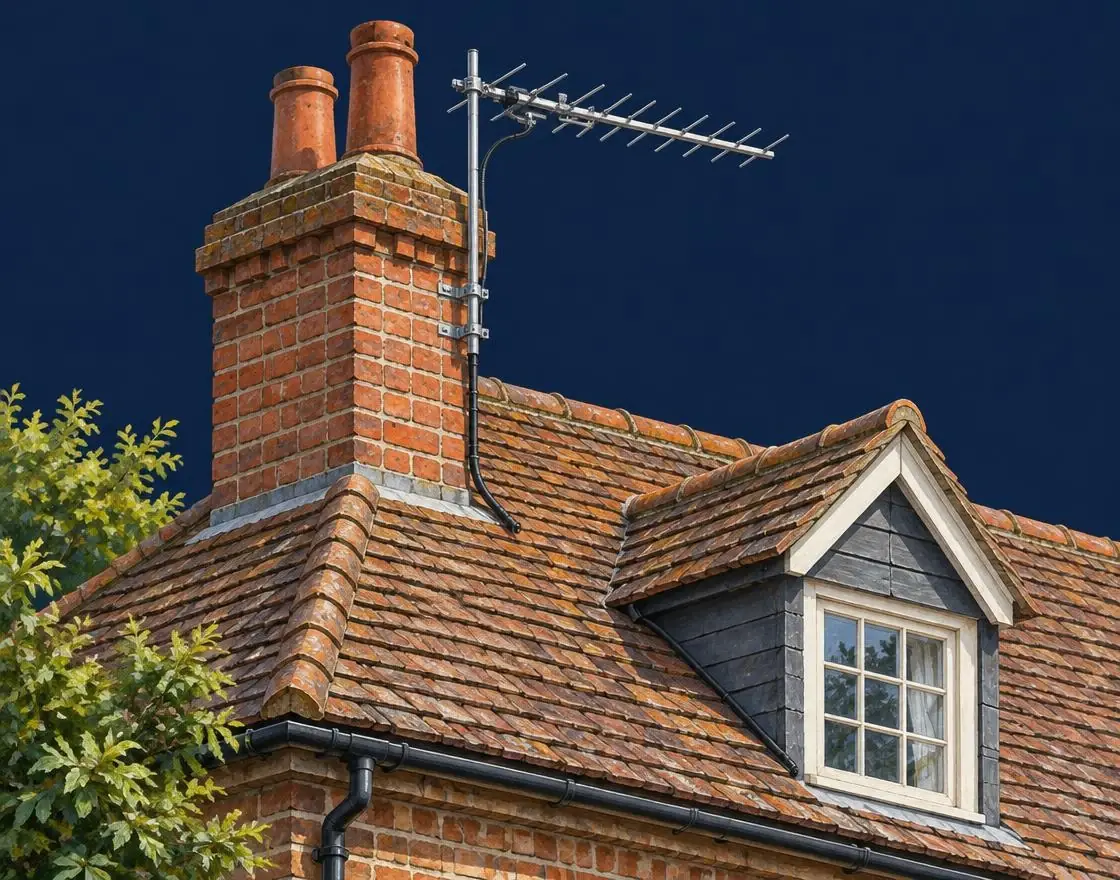
The storm season is properly under way. Storm Austen, the first named storm of 2026/27, crossed southern Britain on 23 October, with yellow wind warnings across much of England and Wales. Storm Boelo followed over the weekend, mostly further north. More will come before spring. After windy nights, the question we hear most is a simple one: the TV was fine yesterday, so is the aerial broken?
Sometimes it is. Often it isn’t. Here’s how to tell the difference without going anywhere near a ladder.
First, rule out the things that aren’t your aerial
A picture that freezes, breaks into blocks or says “no signal” after a storm has a few possible causes. Two of them cost nothing to check.
Is it the transmitter?
High winds and power cuts can affect transmitters as well as houses. Before you assume the worst, put your postcode into the Freeview Channel Checker on the Freeview website. It shows coverage at your address and any known problems or engineering work in your area. If there’s a fault listed, wait. It isn’t your aerial, and nobody needs to climb on your roof. You can also call the Freeview Advice Line on 03456 505050, Monday to Friday, 9am to 6pm.
Does the TV just need a retune?
If the power went off during the storm, a TV or set-top box can come back confused. Run one retune (sometimes called “auto tune” or “first-time installation”) from the settings menu. If you get all your channels back with a steady picture, you’re done. You don’t need us.
If the retune finds fewer channels than before, or some channels break up and others don’t, retuning again won’t fix it. That pattern usually points to a weaker signal reaching the TV, and after a storm the usual reason is the aerial or its cable.
Satellite: weather or damage?
Freesat says heavy rain, strong winds or snow can temporarily disrupt the satellite signal. If your Freesat or Sky picture drops out during the storm and comes back once it passes, the dish is probably fine. If it stays poor in clear, calm weather, the dish may have been knocked off its aim or the LNB, the small unit on the end of the arm, may be faulty.
What you can safely check from the ground
Stay off the roof. Wet tiles, wind and an aerial that might already be loose are a bad combination, and Freesat’s own advice is not to climb onto the roof or use ladders. Everything worth checking can be seen from the garden or the pavement, ideally with a pair of binoculars.
- Which way it points. Compare your aerial with your neighbours’. In most streets they all face the same transmitter. If yours is now pointing somewhere else, the wind has turned it on its pole.
- Whether it’s level. An aerial that has tipped forward or rolled sideways has usually slipped in its clamp.
- The pole and bracket. A bent pole, or a chimney bracket that has slid down or come away from the brickwork, is more serious than a twisted aerial. It can come down in the next gale.
- The cable. Look for cable flapping free down the wall or hanging off the aerial. Wind can pull the connection loose, and once water gets into the joint the signal fades over the following days.
- The dish. For satellite, check the dish is still square on its wall bracket and the arm isn’t bent. Look for anything new in the way, such as a fallen branch, or scaffolding.
If anything is hanging loose or leaning, keep people and cars out of the way underneath it, and get it made safe rather than waiting for the next storm to finish the job.
Why exposed and hilly spots feel it first
Wind damage isn’t spread evenly. The homes we see it on most are the ones where the aerial has to be high and the ground is open, and the ones where the signal was only just good enough to begin with.
Hindhead is one of the highest villages in Surrey. Height helps reception, and many homes there take a strong signal from the Midhurst transmitter. But to clear the tall pines around Grayshott and Beacon Hill, aerials are often mounted high on the chimney, where they take the full force of the wind. Loose fixings and twisted aerials are common after a big blow. Our Hindhead aerial page explains how we set them up there.
Haslemere has the opposite problem. Much of the town sits in a wooded valley, and some streets are in a partial signal shadow. An aerial there may have been aimed carefully to get a stable picture from Midhurst, with not much signal to spare. A few degrees of movement in the wind can be enough to tip it from fine to unwatchable, even when the aerial looks almost right from the ground. There’s more on that on our page about TV aerials in Haslemere.
Around Dorking, the North Downs block the direct signal from Crystal Palace for much of the town, so most aerials point at the Reigate transmitter instead. Out towards Westcott, Brockham and the other Mole Valley villages, woodland adds to it. If a storm has knocked a Dorking aerial and you’re now missing channels, it’s also worth knowing that the small local relay is Freeview Light, which carries only the public service channels. Our Dorking aerial page covers which transmitter suits which part of town.
In all three places, the fix after a storm is usually the same: put the aerial back where it should point, tighten or replace the fixings, and remake any wet connections. Occasionally the storm shows up a mast or bracket that was already tired, and that’s the time to replace it properly.
Insurance, and getting it fixed
Whether an aerial or dish is covered depends on your home insurance policy, so check the wording or ask your insurer. The Association of British Insurers’ general storm advice is to contact your insurer as soon as you can, to speak to them before arranging emergency repairs, and to keep the receipts if you pay for work yourself. It also points out that some things, such as fences, may not be covered as standard. Keeping your property maintained is part of most policies, which is worth bearing in mind if an old aerial was already in poor shape.
Whoever you call, ask them to test the signal at the TV once the aerial or dish is back in place, not just to look at it. An aerial can be pointing roughly the right way and still be delivering a weak signal through a damaged cable. Freeview suggests getting more than one quote, which is sensible advice for any roof work.
What we’re telling customers
Check the Channel Checker and try one retune before you ring anyone. If the aerial has visibly moved or something is hanging loose, don’t touch it and don’t wait for it to sort itself out. Most storm repairs are a realignment and new fixings, not a new aerial, and we’ll tell you if that’s all you need. If the mast or bracket is worn out, we’ll say so and explain why, rather than refit it and hope.
Before the next storm
You can’t storm-proof an aerial completely, but you can stop a small problem becoming a big one. If you’ve noticed your picture getting worse every time it’s windy, or the aerial has been leaning for a while, that’s worth sorting before a winter of gales rather than after. The same goes for a satellite dish that has started losing signal in weather that never used to bother it.
If your aerial or dish needs putting right, our TV aerial repair service covers realignment, new fixings and replacement across Surrey and Berkshire, and our satellite service realigns and repairs Freesat and Sky dishes. Most jobs are priced on the phone.
Questions we get asked
Why has my TV signal gone after a storm?
The most common reason is that the wind has moved the aerial or dish slightly, so it no longer points accurately at the transmitter or satellite. It can also be a loose or water-damaged cable, a fault at the transmitter, or power cuts that left your TV or box needing a retune.
How can I tell if my aerial has moved?
Look at it from the garden or the street, ideally with binoculars, and compare it with your neighbours’ aerials. If yours points a different way, is tilted, is leaning on its pole, or has a cable hanging loose, it has probably moved. Never go up a ladder or onto the roof to check.
Should I retune my TV after a storm?
It’s worth trying once. Check the Freeview Channel Checker for any problems in your area first, then run a retune from the TV’s settings menu. If it finds fewer channels than before, or the picture still breaks up, retuning again won’t help and the aerial needs looking at.
My Freesat or Sky picture keeps dropping out in bad weather. Is the dish broken?
Not necessarily. Freesat says heavy rain, strong winds or snow can temporarily disrupt the satellite signal. If the picture comes back when the weather clears, the dish is probably fine. If it stays poor in clear, calm weather, the dish may have been knocked out of alignment or the LNB may be faulty.
Is storm damage to a TV aerial covered by home insurance?
It depends on your policy, so check the wording or ask your insurer. The Association of British Insurers advises contacting your insurer as soon as possible after storm damage, speaking to them before arranging emergency repairs, and keeping receipts for any work you pay for.
Is a leaning aerial dangerous?
It can be. A loose aerial, mast or chimney bracket can fall in the next strong wind, and it can pull at the chimney it’s fixed to. Keep people and cars clear of the area underneath, don’t try to reach it yourself, and get it made safe.
Sources
- Royal Meteorological Society – Storm names 2026/27 announced: 5 things you need to know about the UK’s storm season (1 September 2026)
- ITV News – First named storm of the season to bring strong winds and disrupt travel this week (20 October 2026)
- Cotality Hazard HQ – Storm Austen brings 100 mph gusts to France and the UK (updated 27 October 2026)
- Freeview – Help: weak signal (Channel Checker, Freeview Advice Line)
- Freeview – What transmitter do I receive a signal from?
- Freesat – Help: poor signal
- Association of British Insurers – Insurance advice ahead of Storm Chandra