Black Friday falls on 27 November this year, and the weeks either side of it are when a lot of new TVs come home. In many living rooms, especially older houses, the chimney breast is the obvious wall to put one on. Sometimes that works well. Sometimes it means a hot TV and a sore neck. This guide covers the three things that decide it: heat, height and the wall itself.
First question: is the fire actually used?
This changes everything, so start here.
- A fireplace that’s never lit, or a decorative surround with no working fire, isn’t a heat problem. A TV above it is only a question of viewing height and fixings.
- A gas or electric fire that gets used now and then is usually manageable, but needs checking.
- A wood burner or open fire used most evenings through the winter is the hardest case. It puts out a lot of heat, and much of it rises straight up the face of the chimney breast.
TV manufacturers are clear about this. Samsung’s own mounting guidance says a TV shouldn’t be placed where it’s exposed to a heat source, and names “over a fireplace” as an example. It also asks for at least 10cm of space around the top, bottom and sides for ventilation. TV manuals also list a safe operating temperature range for the set, and that’s the number to work to.
Stove and fireplace makers say the same from the other side. There’s no single safe distance. You follow the fire manufacturer’s stated clearances to combustibles, and the TV maker’s temperature limits, and the TV has to sit comfortably inside both.
How to check the heat yourself
You don’t need us for this part. On a cold evening, run the fire as you normally would for an hour or two. Then:
- Tape a simple room thermometer to the wall where the middle of the TV would be, and leave it for twenty minutes.
- Compare the reading with the operating temperature in your TV’s manual. Remember the TV makes its own heat too, so a reading near the top of the range isn’t good enough.
- Look in the fire’s installation instructions for anything about shelves, mantels or objects above it.
If the wall is only gently warm, you’re probably fine. If it’s hot to the touch, put the TV somewhere else. A deep mantel shelf or a heat deflector below the TV pushes rising heat forward, away from the screen. Think twice about recessing a TV into the chimney breast above a working fire: it brings the set closer to the flue, and it still needs that 10cm of space around it to breathe. Ask whoever installed or services the fire before cutting into the breast.
Check before you buy
If you’re buying a TV in the sales with the chimney breast in mind, download its manual first and look up the operating temperature and the wall-mount (VESA) size. It takes two minutes and saves an awkward conversation with the retailer later.
The height problem
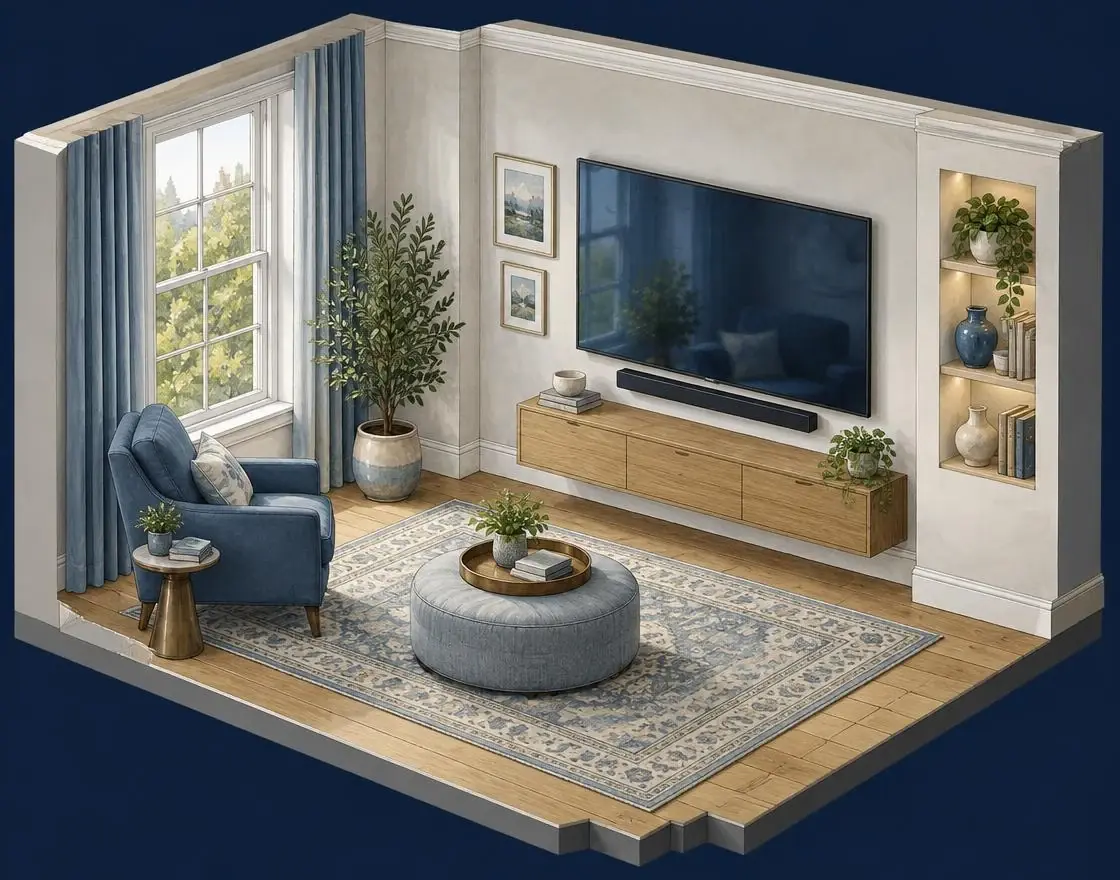
Heat gets the attention, but height is what you live with every day. Above a fireplace, the bottom of the TV has to clear the mantel, so the middle of the screen usually ends up well above where your eyes are when you sit down. The general advice is to have the centre of the screen roughly at seated eye level. A fireplace position can put it a long way above that, and you notice it most during a two-hour film.
There are ways round it:
- Tilting bracket. Angles the screen down towards the sofa. It improves the picture and cuts reflections, but doesn’t make the TV any lower.
- Pull-down bracket. Lets you bring the TV down in front of the mantel when you’re watching and push it back up afterwards. It needs a solid wall, a mantel shallow enough to clear, and a fire that’s off while the TV is down.
- Sit further back. The further the sofa is from the wall, the less a high screen bothers you.
Our TV wall mounting page has a height guide by screen size, including a fireplace setting, which is a useful starting point before anyone picks up a drill.
What’s inside the chimney breast
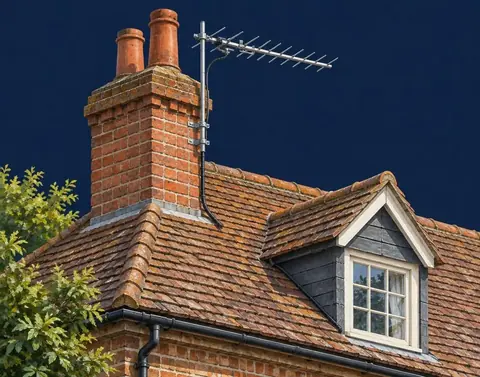
Plenty of homes across Surrey and Berkshire are Victorian and Edwardian, with a chimney breast and an alcove either side in the front room. You see it in the older streets around Reigate, in the period terraces of Windsor and Eton, and in the villas near the centre of Camberley. Those chimney breasts are usually solid, but they aren’t a plain wall:
- The flue runs up the middle. Fixings must not break into it or damage a flue liner. Where a fire is in use, that matters for safety, not just tidiness.
- Old brick and mortar can be soft. Fixings that would hold well in modern blockwork can pull out of crumbly mortar. The fixing has to suit the wall, not just the TV’s weight.
- Newer houses are different. A chimney breast in a modern home may be plasterboard on dabs of adhesive or on a timber or metal frame, which needs a different approach again.
- Cables and pipes can be anywhere. Wiring usually runs in predictable lines in newer homes, but in older or altered houses it can turn up in unexpected places. Scan before drilling, every time.
Then there are the connections. The aerial socket in an older front room is often at skirting level in an alcove, nowhere near where the TV will end up. That can usually be solved by moving the socket, or adding a new one behind the screen, so there’s no lead running across the chimney breast. We can do that on the same visit. It’s the same work as adding extra Freeview points.
When another wall is better
If the heat or height doesn’t work, the alcoves are worth a second look. In many period rooms, one alcove gives a better viewing angle from the sofa than the chimney breast does. It keeps the TV out of the warmest part of the room, and it often puts the screen nearer the existing aerial socket. A full-motion bracket lets you pull it out and turn it towards the seating when you’re watching.
Otherwise, a side wall across from the window often works better than people expect, and leaves the fireplace as the focal point it was built to be.
What we’re telling customers
If the fire is never lit, the chimney breast is often a fine spot and we’ll get the height as comfortable as we can. If it’s a wood burner you use every evening, we’ll usually suggest another wall, and we’ll say so before we start rather than after. Either way, we check the wall and the heat, and agree the height with you, before anything gets drilled.
If you’d like a second opinion on your room, send us a photo of the wall, the TV size and your postcode. We’ll tell you whether the chimney breast will work, or whether you’ll be happier with it somewhere else.
Questions we get asked
Is it safe to put a TV above a log burner?
It can be, but it’s the hardest case. Wood burners give off a lot of radiant heat, and stove makers generally advise against putting a TV directly above one. If you want to try it, measure the wall temperature at the TV position with the stove at full heat, check it against the TV’s operating range in the manual, and follow the stove maker’s clearances to combustibles. A deep mantel shelf below the TV helps push heat away from it.
Is a TV above a gas fire OK?
Gas fires usually throw out less radiant heat than a wood burner, especially room-sealed models, but the chimney breast above can still get warm. Check the fire’s installation instructions for anything about shelves or objects above it, and feel the wall after the fire has been on for an hour or two. If it’s more than gently warm, think about a different wall.
How high should a TV be on the wall?
As a starting point, the middle of the screen should be roughly at your eye level when you’re sitting down. That’s why fireplace positions are often too high. Our wall mounting page has a height guide by screen size you can use as a starting point.
Can I drill into a chimney breast?
Usually, yes, but carefully. The flue runs up inside the breast, and fixings must not break into it or damage a flue liner. Old brick and mortar can also be soft. Find out where the flue sits, use fixings suited to the wall, and scan for cables and pipes before drilling.
Will my TV warranty cover heat damage?
Don’t assume it will. TV manuals list a safe operating temperature and tell you to keep the set away from heat sources. Using a TV outside the conditions in its manual may affect a warranty claim, so check yours before mounting it above a fire that gets used.
Sources
- Samsung UK – How to mount your TV on a wall or stand
- Homebuilding & Renovating – Can you put a TV above a log burner?
- Chesneys – Can I put a TV above my fireplace? (24 November 2025)
- Homebuilding & Renovating – How to avoid drilling into wires (19 July 2025)
- PublicHolidays.co.uk – Black Friday 2026, 2027 and 2028